
When the average person tries to eat healthy, how do they determine what to eat?
Do they calculate how many grams of saturated fat, sodium, and sugar they’ve had that day and choose whichever foods don’t push them past a daily maximum?
Do they measure out how much Vitamin C, potassium, and dietary fiber they need and choose whichever foods have the most?
Or do they just choose whichever foods look healthy from their marketing?
The likely answer is the third one. Most people simply do not have much background knowledge of nutrition, and even those who do are unlikely to achieve a healthy diet by calculating the amounts of specific dietary components they are consuming and comparing them to recommended daily intakes.
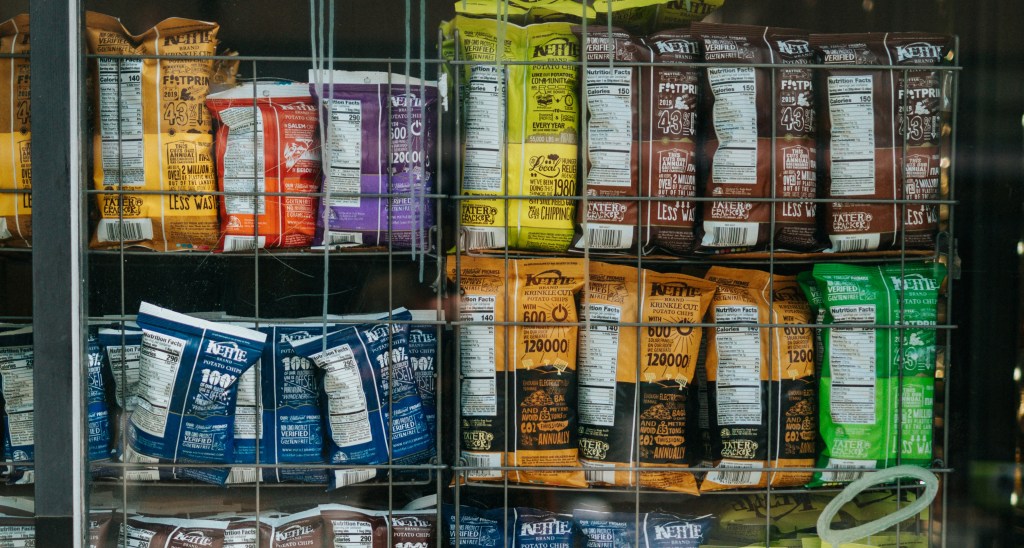
Nevertheless, our nutrition labeling system in the U.S.—known as the Nutrition Facts label—expects consumers to take this approach when choosing their diets.
The Nutrition Facts label was first mandated by the Nutrition Labeling and Education Act of 1990. In its original text, this law required most packaged food products to bear the following information on a back-of-the-package label:
- The serving size or unit typically used
- The number of servings or units per container
- The number of calories per serving, and the number of calories from fat
- The per-serving quantities of total fat, saturated fat, cholesterol, sodium, total carbohydrates, complex carbohydrates, sugars, total protein, and dietary fiber
- The per-serving quantities of specific vitamins, minerals, and other nutrients
This mandatory label also included the “% Daily Value” column, which lists the percentage that one serving contains of each nutrient’s recommended daily minimum or maximum.
The Nutrition Facts label has been updated several times since 1990. The updated panel now shows the quantities of trans fat and added sugars in each serving. It also no longer states how many calories come from fats, nor how many grams of complex carbohydrates are in each serving. Additionally, the numbers used for % Daily Values have been updated over time, as have the minor vitamins and nutrients listed at the bottom.
Despite these updates and minor efforts to improve, the Nutrition Facts label has failed to achieve its purpose of improving Americans’ diets. The American obesity rate has nearly tripled since 1990, child obesity has continued its upward slope, and consumption of unhealthy ultra-processed foods has increased over time. Children today consume about 14% of their total calories from added sugars alone.
There is a lack of evidence that these labels have helped Americans improve their eating habits in any meaningful way, and this is likely due to the label’s design. In fact, a massive 18-country study compared multiple labeling systems and found that the Reference Intakes label—which was most similar in approach to the U.S. Nutrition Facts label—was the least effective system for improving consumer understanding and choices.
There are a number of flaws in the Nutrition Facts label’s design. First and foremost, all quantities are listed ‘per serving,’ and some packages even contain decimal numbers of servings. That means that consumers often have to do mental math to calculate how many calories, sugars, and other quantities they are consuming—a process that many people struggle with or are unwilling to do. Thanks to this design decision, large portions of consumers struggle to parse even basic information, such as calories per container, from the label.
Further, the “% Daily Value” column does not differentiate between a minimum daily value and a maximum daily value. For example, the % Daily Value for dietary fiber means that people should consume 100% or more per day, while the % Daily Value for saturated fat means that people should consume 100% or less per day, yet both values are displayed in the exact same way. For people without nutritional background knowledge, this can be very confusing, and it could lead to consumers seeking out the very foods they should be avoiding.
There are also plenty of loopholes that can be used to mislead consumers. Despite the fact that serving sizes are regulated by the government, producers often find ways to set unrealistically small serving sizes in order to minimize the listed quantities of components like calories or sugar. Additionally, if the quantity of a component like trans fat is 0.5 grams or less per serving, producers are allowed to write “0 grams” and can hide it altogether. As for the ingredients list: since ingredients are listed by weight, many producers use substances such as added sugars in multiple forms (like sucrose, maltose, etc.) so that they appear lower on the list overall.
However, none of these flaws are as important as the fact that the Nutrition Facts label is fundamentally not very useful or relevant for the average consumer. Most people are simply unwilling or unable to add up quantities of different nutrients across foods when choosing what to buy.
Even if they were, that wouldn’t be an efficient way to make dietary decisions. A far better, simpler way is to simply base one’s diet on minimally processed foods, especially from groups like vegetables, fruits, and whole grains, while limiting ultra-processed foods and specific food groups that are high in unhealthy components and low in nutritional value. Nutrition is about so much more than eating the right quantities of a few components like saturated fat and sugars: it is also about micronutrients, additives, GI, chemical structure, and other qualities in foods, which are overwhelmingly better for you when those foods are less processed.
By following the Nutrition Facts label, someone could spurn nutritious foods like unprocessed frozen fruit and extra-virgin olive oil (which are high in sugars and fat respectively) while basing their diet on unhealthy foods like refined carbs and artificially-sweetened desserts, which may not surpass the % Daily Value for any component. This labeling system does not make any distinction between different food groups, nor between ultra-processed and whole foods. It is also nonevaluative; it doesn’t clearly convey that any foods, even the worst offenders, should be limited or avoided.
Nutrition labels need to be more holistic, more easily understandable, and more direct in their recommendations. Fortunately, there are several labeling systems already in use around the world that have proven to be more effective.
One such system is the Nutri-Score label. This front-of-package label, invented in France and used in nine European countries today, gives food items a grade on a five-letter scale from A (best) to E (worst). Grades are determined using a point system that takes into account several nutritional factors. These factors include caloric density, sodium content, fiber content, protein content, saturated fat content, and sugar content, as well as whether a food belongs to an unprocessed, nutritious food group such as fruits, olive oil, or nuts.
Foods that are holistically healthy—for instance, unprocessed beans or packaged foods high in important nutrients and low in harmful components – will receive a clearly-visible, self-explanatory, dark green “A” on the front of their package. Foods that are nutritionally empty and full of components like added sugars, such as sodas or processed meats, will receive an orange “D” or “E.” This system makes it abundantly clear to consumers which foods should be consumed and which should be limited, without requiring mental math or nutritional knowledge. And it is generally accurate; a multi-country study found that consuming more foods with poor Nutri-Score grades was linked with greater risk of cardiovascular disease.
Implementing a system like Nutri-Score labeling would not necessitate removing the Nutrition Facts label, since they are placed on opposite sides of the package. While the Nutrition Facts label should be updated to improve its clarity and ease of comprehension, even just adding a small front-of-package label could go a long way in improving consumers’ dietary choices. Something as simple as a front-of-package warning sign for foods high in components like added sugars or saturated fat can be effective in driving better dietary choices.
In a free society, information is one of the most important policy tools for improving people’s decisions. If we want to improve the poor dietary quality and public health of our country, smarter nutrition labeling is an excellent place to start—and we have plenty of successful examples around the world to learn from.
References:
U.S. Food and Drug Administration. (2024). The Nutrition Facts Label. FDA.


 I'll Have What They're Having
Leave a comment