
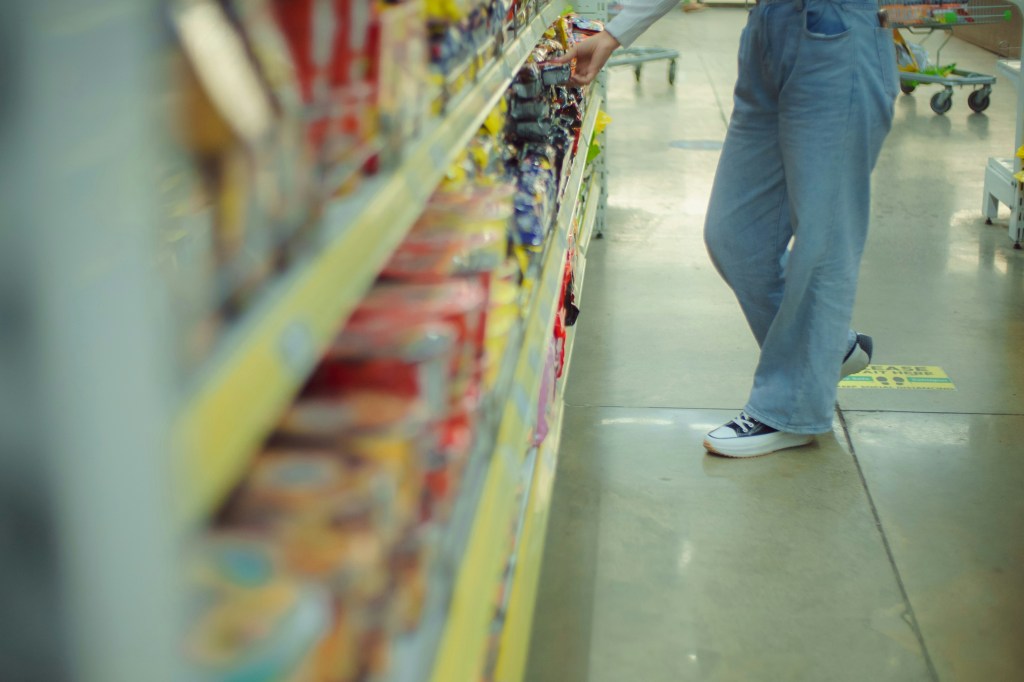
The following is an excerpt from my upcoming book, I’ll Have What They’re Having, which will be released in the coming weeks. This chapter is titled, “A Walk Through The Typical American Supermarket.”
Let’s take an imaginary walk together through an average, run-of-the-mill American supermarket to understand how government subsidies affect our diets.
As a note, the food prices I refer to will be rough estimates based on my own experiences as well as the websites of major grocery chains.
Let’s start at the entrance. As we walk to grab a shopping cart, we look up and see the familiar name of the supermarket chain in big letters above the doors. We roll our cart into the building and double-check our grocery list—just the basics.
First up, let’s walk to the bakery section. We see cakes, cookies, muffins, donuts, loaves of bread—plenty of them, sold in large packages at low prices. We could get thousands of calories’ worth of food here for just a few dollars. Sure, most of these products are made of essentially the same ingredients—refined flour, high-fructose corn syrup or sugar, soybean oil, artificial flavors, and preservatives—and many of these items were baked in factories weeks ago instead of fresh this morning. But I’m hungry, and the prices are so low for these bread-based foods, $2–4 for most items—so let’s just grab a box of muffins and a pack of bagels.
Up next, the breakfast section. We see all sorts of colorful breakfast cereals—whole boxes being sold for just a few bucks. Most of the cereals are made of refined grains like corn or wheat, mixed with petroleum-based food dyes and tons of high-fructose corn syrup. The boxes are marketed toward children, featuring smiling cartoon characters. Moving down the aisle, we walk past some more classic options like pancake mix, frozen waffles, and French toast sticks, mostly made from that same familiar combination of refined flour, sugar, soybean oil, artificial flavors, and preservatives. But at least they’re cheap—let’s grab a $4 box of frozen waffles and keep going.
Up next, we pass the snack food section, full of well-marketed, addictive ultra-processed snacks. Almost all of these foods are made primarily of refined carbs like cornmeal or refined flour and packed full of additives like high-fructose corn syrup, soybean oil, sodium, and artificial flavors. Their calorie counts are high relative to their prices. At the end of the aisle, we spot a few bags of salted nuts, offering a healthier snack. That party-sized bag of cheese puffs is cheaper, though… let’s grab that instead.
One aisle over is the beverages section, offering all sorts of sweet energy drinks, sodas, and juices. This isn’t where we’d expect to find corn, but the most common ingredient here (besides water) is high-fructose corn syrup. Some of these drinks are being sold as cheaply as bottled water—less than $1 per bottle! Nearly everything in this section is nutritionally empty, high in calories, and full of sugar, but at those prices, it’s definitely tempting to buy a pack.
So far, you may be noticing a trend—a lot of the cheapest, most high-calorie foods are made of the same few ingredients—refined grains like corn, soy, and wheat and their derivatives. Let’s move on to the next part of the store and see what else we notice.
We arrive at the meat and dairy sections. Walking around, we see all sorts of animal foods, processed and unprocessed—beef, eggs, ham, chicken, milk, sausage, cheese, and more. A lot of the prices we see here are unintuitively low, considering how much food, water, and time it takes to raise an animal—we’re seeing ground beef and chicken selling for just a few bucks per pound, and whole gallons of milk for less than $5. We notice something else—some of the foods are labeled “grass-fed” or “pasture-raised,” and these seem to be priced much higher than the rest.
As it turns out, grass and pasture forage are the natural diets of livestock animals. However, the cheaper, standard products that most people buy come from factory-farmed animals that were fed—you guessed it—refined grains like corn, soy, and wheat!
Just a few more sections to go. We pass through the frozen food aisles, in awe of the seemingly endless variety of easy, appealing meal options. Looking closely, however, we start to notice that almost every package—from orange chicken to fettuccine Alfredo to beef taquitos—has essentially the same core ingredients: a refined grain like white rice, white pasta, or refined flour; a processed, grain-fed animal product like breaded chicken or cheese; a refined oil like soybean oil or corn oil; and a multitude of preservatives and other additives. Vegetable components, if they are included at all, are typically a minuscule part of these meals.
Finally, we arrive at the other end of the store, to our last destination: the produce section. Here we have all sorts of fresh fruits and vegetables—the things most of us aren’t eating enough of. There’s only one thing left on our grocery list: blueberries. After a bit of searching, we find a 1-pound, 250-calorie pack of blueberries, and it’s… $8?
Something doesn’t add up. Looking back on our trip through the grocery store, that 250-calorie pack of blueberries would cost us approximately as much as:
- A pack of bagels, a loaf of bread, and an 8-pack of cookies (~4000 calories)
- 1 pound of conventional ground beef (~1200 calories)
- 1 frozen dinner plus 2 packs of instant ramen (~1100–1600 calories)
- 5 boxes of white pasta (~8000 calories)
- A 12-pack of soda (~1500 calories)
- A box of breakfast cereal plus a half gallon of milk (~2500 calories)
How is it possible that a single pack of blueberries, which simply had to be grown in a field, harvested, then shipped to the store, could cost so much more than ultra-processed foods—for which producers had to harvest multiple crops (mainly corn, wheat, and soybeans), ship them to factories, process them with advanced machinery and human labor, combine them with other ingredients and lab-made chemical additives, package them, ship them to stores, and market them?
How, exactly, can a pound of blueberries cost as much as a pound of beef from a cow that had to consume several metric tons of food and thousands of gallons of water before it was slaughtered?
And most importantly, why does it seem that unhealthy, calorie-dense foods tend to be much cheaper than healthy, whole foods?
In the next chapter, we’ll answer these questions.
I hope you enjoyed. Stay tuned if you’d like to keep reading—the full book is coming soon!

 I'll Have What They're Having
Leave a comment